Hi, I'm hakairyuousinn (my X account).
When I make a game with Claude Code, I go in this order.
- Write down what I'm making (rules, controls, how the screens flow)
- Write a build brief (what each file does, and when the job counts as done)
- Build it (I hand this part to Codex)
- Have the game played to the end automatically, and look at screenshots
- Turn anything that looks wrong into a fix brief, then check again
- Put it on my site, and fix the bugs that show up after that
Before any code gets written, I put down in words what I'm making and what "done" means. That's pretty much it.
I made Kitsune Den, a dice game where you bluff against foxes, in this order, from the brief on October 27 to the launch on October 31.
What went into the build brief
Claude wrote the brief. It starts with what was already there: the background, art of the three foxes, the voice files. Plus the language switching and sound effect code I copied over from my earlier digging game, Dig It!.
After that comes a table of the files to make, and how one match plays out. The help text for first-time players was also decided in the brief. "These are your dice. The foxes cannot see them." in the screen below is almost word for word from it.
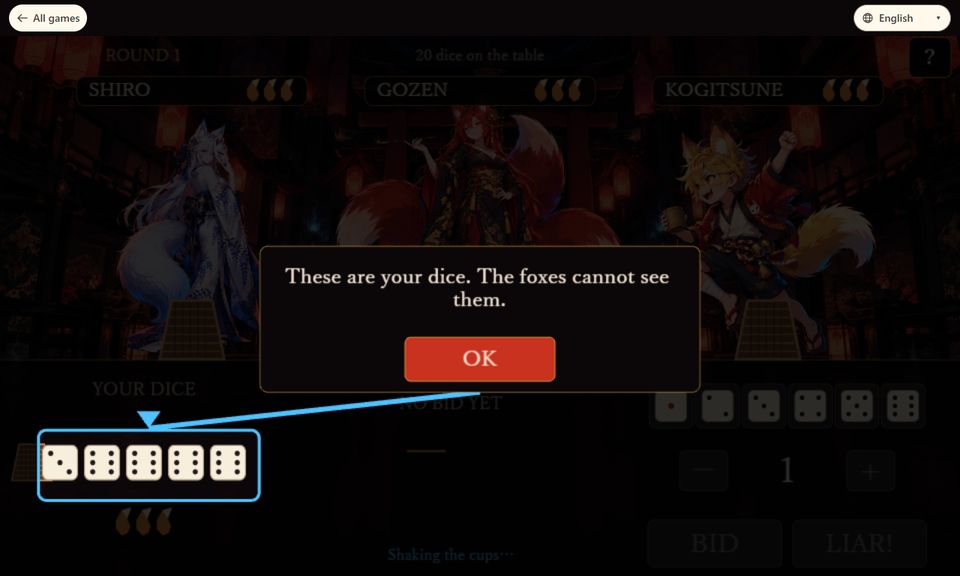
The brief ends with the finish conditions. For Kitsune Den they were:
- The build passes with no type errors
- On a PC in landscape and on a phone in portrait, you can play from the title through the result screen and the share-to-X button
- A player who ignores the foxes' tells wins 20–40% of the time in a four-player game
- The game's notes file (AGENTS.md) gets updated with how to run it
- A short report of "which files changed and the key points"
To measure the win rate, the same brief had Codex build a way to run matches with no screen. Later I had it play 1,000 games: 36.2%, with an average of 9.3 rounds per game. Read the tells and it's built so you win more.
No errors, but I still look at the screen
The build came back from Codex on October 28. It had stopped near the end with a "model is busy" message, but the code, the build and the tests Codex wrote for itself were all finished.
Then it was Claude's turn. It had the game played from the title to the result screen and took a screenshot of each scene, once in landscape in Japanese and once in portrait in English. Not a single error. But the screenshots showed things like the foxes' tail icons sitting on their faces. Six things to fix. I sent them back to Codex as a fix brief, and they were fixed the same day. The before and after screens are in Claude Code vs Codex: How I Use Both to Make a Game.
One small headache: when the browser inside the app is in the background, the game drops to one frame per second. So I take screenshots with a separate browser (Playwright) instead. Having an AI play blind, with no idea of the rules, is a different approach, and I wrote about it in I let AI play my game blind. It starved on the first try.
Launch day, and the fixes after
On October 31 I put it on this site's games page. On the same day I fixed a bug where, on phones, the game wouldn't finish starting until you tapped the screen. It used to load all the fox voices at startup. Now they load in the background on the title and match screens.
After that, it became playable in English on November 4 and in Korean on November 5. Language switching works the same way as in my other games.