Hi, I'm hakairyuousinn (my X account).
Claude Code and Codex are both AI tools that read code, write it, run it and check the result. The biggest difference is who makes them: Claude Code comes from Anthropic and Codex from OpenAI. The models running inside them are different too.
I use both to make games. Claude gives instructions and checks the work, and Codex implements and fixes. I ended up here because I wanted to save my Claude usage. I haven't compared which one is smarter, so I can't tell you anything about performance…
| Comparing | Claude Code | Codex |
|---|---|---|
| Made by | Anthropic | OpenAI |
| File for project rules | CLAUDE.md | AGENTS.md |
| Runs in (official pages, November 5, 2026) | Terminal, editors, desktop app, web | Terminal, editors, ChatGPT apps and web, cloud |
| What I ask it to do | Write briefs, look at the screens and check them, write video narration | Research, drafts, implementation, fixes |
How I used both on my fox game
This is from Kitsune Den, a dice game where you bluff against foxes.
On October 27, Claude wrote the brief. It's pretty detailed, from what each file does to which fox's voice plays in which scene.
I handed it to Codex to implement, and right near the end it stopped with “model is busy.” But the code, the build and its own tests were already done, so I just moved on.
Then Claude checked what came out. It played from the title screen to the results screen without a single error.
But the screenshots showed plenty of things wrong. The tail icons sat on the foxes' faces. The screen still said “your turn” after you had made your bid. The foxes' speech bubbles only said “2 × 6” in text, so it was hard to tell that the 6 meant a die face.
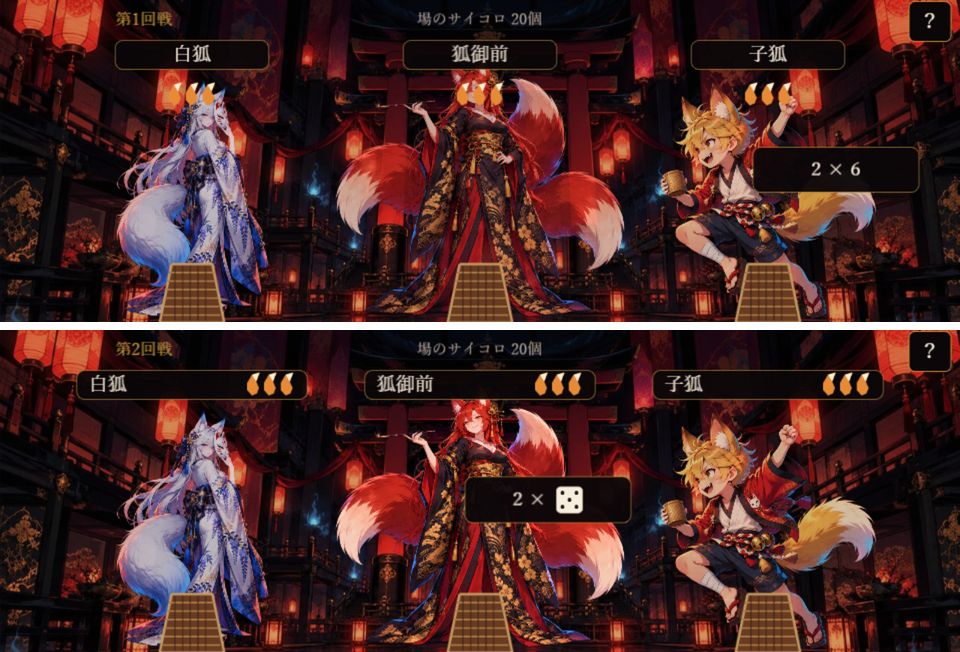
The fix brief I gave Codex
There were six things to fix, so they went into a fix brief for Codex. Here's the actual text for the tail icons, translated from Japanese.
In landscape, the foxes' tail icons overlap their faces (…) In landscape, widen the name plate to 0.24w and put the name on the left and the 3 tail icons on the right inside it. Leave portrait as it is
Done when: npm run build passes. (…) The 6 points above are fixed in the screenshots. At the end, briefly report “the files you changed and the main points.”
I include the “done when” part and the short report every time. If the report is long, Claude uses up my usage just reading it.
According to the report that came back, it tried three screen sizes, including phone portrait and PC landscape, in Japanese and English, and all of them passed. Claude mostly looks at that report and at what changed. Rereading everything wouldn't save anything…
No errors, but it looks wrong. I'd have missed that if I'd only read the test results. I also wrote about having AI play games to check them in “I let AI play my game blind. It starved on the first try.”
What I stopped giving to Codex
Video scripts. When Codex wrote one, the Japanese read like a translation and felt unnatural (October 24). Since then, Claude writes the narration, and I ask Codex to fact-check the research and count characters. That script is the only time this came up for me, and I haven't compared them on other writing.
Codex also sometimes gets stopped by permissions, for example when moving files outside the working folder. When that happens, I don't hand the whole job to Claude. Claude only does the part that was blocked.
How to make both read the same rules
Claude Code reads CLAUDE.md and Codex reads AGENTS.md. If you write the same thing in two places, they'll drift apart eventually. On top of that, when a CLAUDE.md exists, Claude Code doesn't read AGENTS.md by default (official docs).
In this site's folder, I only write in AGENTS.md, and CLAUDE.md is a symbolic link to it (a kind of alias). On Windows, creating one needs Developer Mode or administrator rights. If links are a hassle, the docs also describe writing @AGENTS.md inside CLAUDE.md.