Hi, I'm hakairyuousinn (my X account).
On November 9 I made and released Hexa Drop, a falling-block puzzle played on hexagon cells. What I learned is that a falling puzzle becomes playable once you decide four things: the board, the falling pieces, how things clear, and how you lose. Here's what I picked for Hexa Drop.
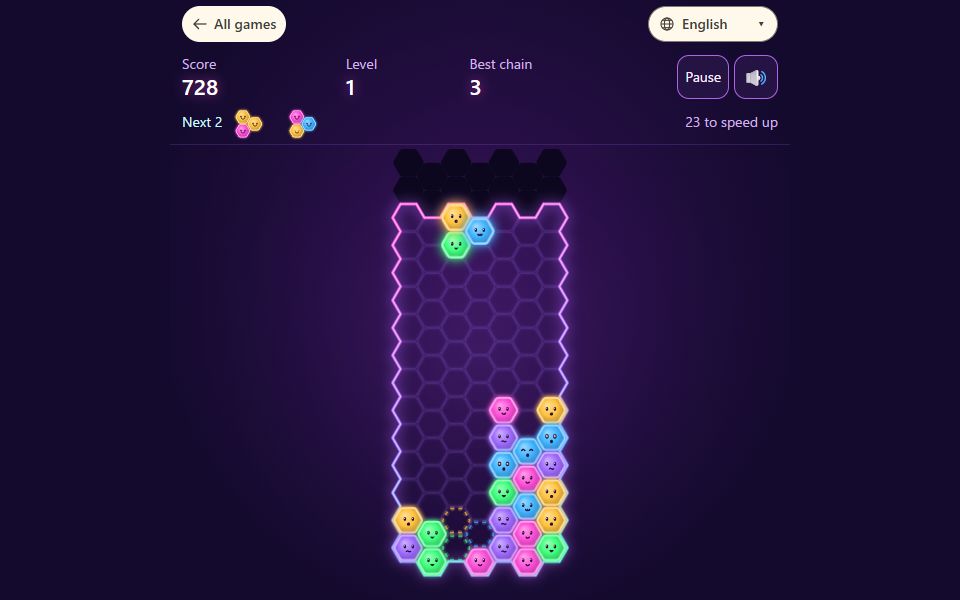
- Board: hexagon cells, 7 columns by 13 rows, plus 2 hidden rows on top
- Pieces: a trio of three hexagons touching at one point. Rotates 60 degrees at a time
- Clearing: 4 or more of the same color connected disappear. If things fall and line up again, that's a chain
- Losing: once everything has fallen and the chains are over, if a piece is left in the hidden rows, the game ends
- Controls: arrow keys on a computer. On a phone, drag to move, tap to rotate, flick down to drop
The rest is the number of colors and the falling speed. Hexa Drop has 5 colors, and every 40 cleared the level goes up and pieces fall faster.
The first commit of the prototype was a little after 4 p.m., and it went live just before midnight. I gave the theme, and let Claude Code decide the detailed rules (how I work is in How I Make a Game with Claude Code).
Shift every other column by half a cell
If you line up hexagons with a flat side on top, neighboring columns don't mesh as they are. So only the odd columns are shifted down by half a cell. That way every cell gets 6 neighbors.
When a piece lands, the three hexagons split and each one falls straight down its own column. So the shape breaks apart after you place it, and colors sometimes line up where you didn't expect.
With 4 colors, it never ended even with random moves
It started with 4 colors. I had a program play it by placing pieces at random, and it went past about 100 pieces without losing. Chains were even happening on their own. If you can keep going without thinking, it's too easy as a puzzle...
So I went to 5 colors. With the same random placement it tops out after about 35 pieces. A program that looks just one move ahead lasted over 400. Both are numbers from automatic play, so I'm still watching how it feels for people.
I also redid the colors once. With the first look, I was told blue, green and yellow were hard to tell apart. Now it's pink, sky blue, green, amber and purple, and each color has a different mouth shape on its face.
You lost the moment a piece appeared, with no idea why
In the first version, if the spot where new pieces appear was blocked, you lost right there. Once the stack got high, the game ended the instant a piece showed up. The player can't tell why they lost.
So I rebuilt the losing rule along the lines of the official Tetris rules.
- Pieces come out of 2 hidden rows above the board
- A piece doesn't lock for 0.4 seconds after landing, so you can slide it away. Moving it extends that a little
- You only lose after everything has fallen and all chains are over
- When you lose, the overflowing cells blink red for one second before the result shows
Even when it's stacked to the top, you can keep going if a chain clears it. Getting saved at the last second feels kind of nice.
After release, only sharing to X from a computer didn't work
From the result screen you can share to X with an image of your score. Right after release I tried it on the live site, and only sharing from a computer failed to make the card with the image.
The cause was file size. The share images were about 830,000 to 880,000 bytes, over the site's 600KB limit. I made the image colors a bit coarser and got them down to about 300,000 bytes. The only visible difference is faint banding in the background gradient. How the share cards work is in the post on turning game results into X cards.
Scoring and chain multipliers are on the how-to-play page. Let me know how long a chain you managed.